Evolved Gas Analysis (EGA): Linking TGA with Mass Spectrometry
Introduction
Thermogravimetric Analysis (TGA) provides phenomenal, quantitative precision. It can tell you with absolute certainty that your sample just burned off exactly 14.5% of its mass at 300°C. However, traditional TGA possesses a fatal flaw in advanced deformulation and forensic science: it tells you how much you lost, but it cannot tell you what you lost. Was that 14.5% mass drop harmless water vapor? Toxic formaldehyde? Plasticizer? Or a vital flame retardant?
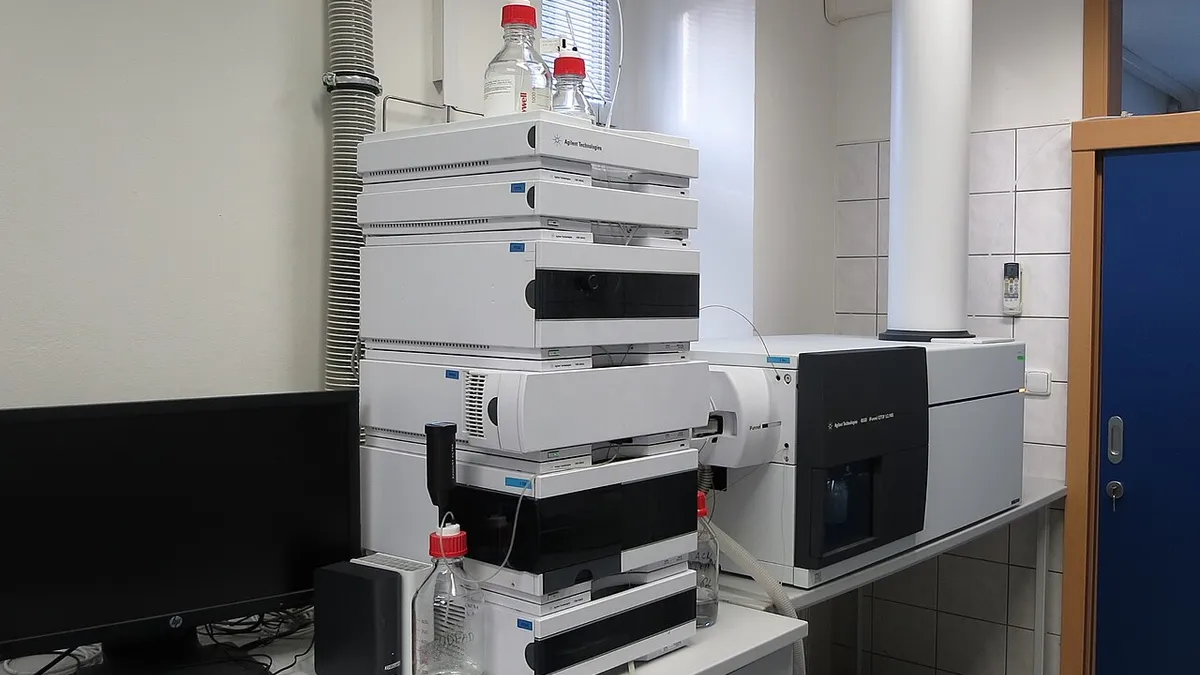
To solve this riddle, the thermal analysis industry couples the quantitative weight-loss power of TGA with the qualitative chemical identification power of Mass Spectrometry (MS). This combination—known as Evolved Gas Analysis (EGA) or TGA-MS—represents the absolute pinnacle of materials forensics.
The Architecture of a TGA-MS System
Combining two highly complex analytical instruments requires meticulous engineering to preserve the integrity of the data.
1. The TGA Furnace: The sample is heated in the TGA furnace under a highly controlled flow of carrier gas (typically helium, as it is inert and ideal for Mass Spec).
2. The Heated Transfer Line: As the sample degrades and evolves "smoke" or gases, these exhausts are instantly pulled into a fused-silica capillary transfer line. Crucially, this transfer line is heavily insulated and heated to roughly 250°C to 300°C. If the line was cold, the heavy off-gassed polymers would condense inside the line like grease in a chimney, never reaching the Mass Spec.
3. The Mass Spectrometer: The gases enter the MS, are bombarded by electrons to ionize and fragment them, and are then sorted by their mass-to-charge ratio (m/z).
The output is glorious: a simultaneous display of the TGA mass-loss step occurring simultaneously with the MS charting out the exact elemental isotopes of the evolved chemical.
Differentiating Overlapping Degraddations
A primary use of TGA-MS is deconvoluting complex degradation profiles.
Imagine heating a flame-retardant cable sheath. The TGA shows a massive, continuous, singular drop in mass from 200°C to 450°C. It looks like one singular burn-off event.
However, the coupled Mass Spectrometer tells an entirely different story. By tracking specific ion masses in real-time, the MS proves that multiple events occurred simultaneously:
- At 220°C: The MS detects an m/z of 18 (Water), identifying the activation of aluminum hydroxide flame retardants.
- At 280°C: The MS registers massive spikes in m/z 36 and 38 (Hydrogen Chloride), proving the PVC base polymer has begun stripping its corrosive chlorine atoms.
- At 400°C: The MS catches heavily fragmented benzene rings (m/z 77, 91), indicating the structural collapse of a plasticizer.
What the TGA saw as a single step, the MS proved was three distinct, sequential chemical failures.
Case Study: Lithium-Ion Battery Venting
A battery engineering team was attempting to map the thermal runaway off-gassing profile of their latest high-nickel cathode formulation. Specifically, they needed to know the exact temperature the cathode began venting pure oxygen (which dangerously feeds the runaway fire).
Using TGA-MS, they slowly heated the fully charged cathode material in an inert argon environment. The TGA recorded a subtle 2% mass loss step beginning at 215°C. At that exact millisecond, the Mass Spec registered a violent, singular spike for m/z 32, confirming absolute oxygen generation. This hyper-specific TGA-MS data legally proved to regulators that the cathode remained inert well past the required 150°C failure threshold.
The Advantage of Skimmer Systems
While capillary transfer lines are excellent, elite systems utilize "Skimmer" couplings. These systems dock the Mass Spectrometer directly above the TGA furnace, literally "skimming" the gases directly out of the crucible without tubes. This eliminates the risk of heavy compounds condensing in transit, allowing for the real-time mass-spec evaluation of incredibly heavy polymeric tar and massive biological macromolecules.
Related Resources
Compare complex hyphenation techniques and software overlay capabilities:
Conclusion
Evolved Gas Analysis shifts TGA from a quantitative scale into a definitive chemical identification machine. By flawlessly hyphenating the brutal combustion of the TGA with the intricate isotopic sorting of Mass Spectrometry, scientists can unmask the exact chemical identity of every vapor, plasticizer, and toxic breakdown product hidden within complex industrial materials.
Need Expert Thermal Analysis?
Our METTLER TOLEDO-equipped lab delivers precise, NABL-traceable results for DSC, TGA, RC1, and more.
Book Free ConsultationShare Article
Related Articles
TGA-FTIR vs TGA-MS: Choosing the Right Hyphenated Technique
Evolved Gas Analysis relies on hyphenation. Compare the specific strengths, weaknesses, and use-cases of TGA-FTIR versus TGA-MS for materials characterization.
Thermal AnalysisTGA-FTIR Hyphenated Techniques for Deformulation Studies
Discover how coupling Thermogravimetric Analysis with Fourier Transform Infrared Spectroscopy (TGA-FTIR) revolutionizes material deformulation and evolved gas analysis.
PharmaceuticalsGlass Transition Temperature (Tg): Why it Matters in Pharma
Understand why the Glass Transition Temperature (Tg) is the most critical parameter for ensuring the stability of amorphous solid dispersions in pharmaceuticals.