Purity Analysis by DSC: The Van ''t Hoff Equation Explained
Introduction
In the realm of pharmaceutical manufacturing, measuring the purity of an active pharmaceutical ingredient (API) is a regulatory imperative. While high-performance liquid chromatography (HPLC) is the traditional go-to method, it has a significant blind spot: it requires reference standards and does not easily detect inorganic impurities that lack a chromophore.
Differential Scanning Calorimetry (DSC), however, offers an absolute method for purity determination that requires no reference standard for the impurity. Through the application of the Van 't Hoff equation, DSC relates the lowering and broadening of a substance's melting point directly to the molar fraction of impurities present. This comprehensive guide uncovers how the Van 't Hoff principle is applied in modern DSC to achieve rapid, highly accurate purity assays.
The Principle of Melting Point Depression
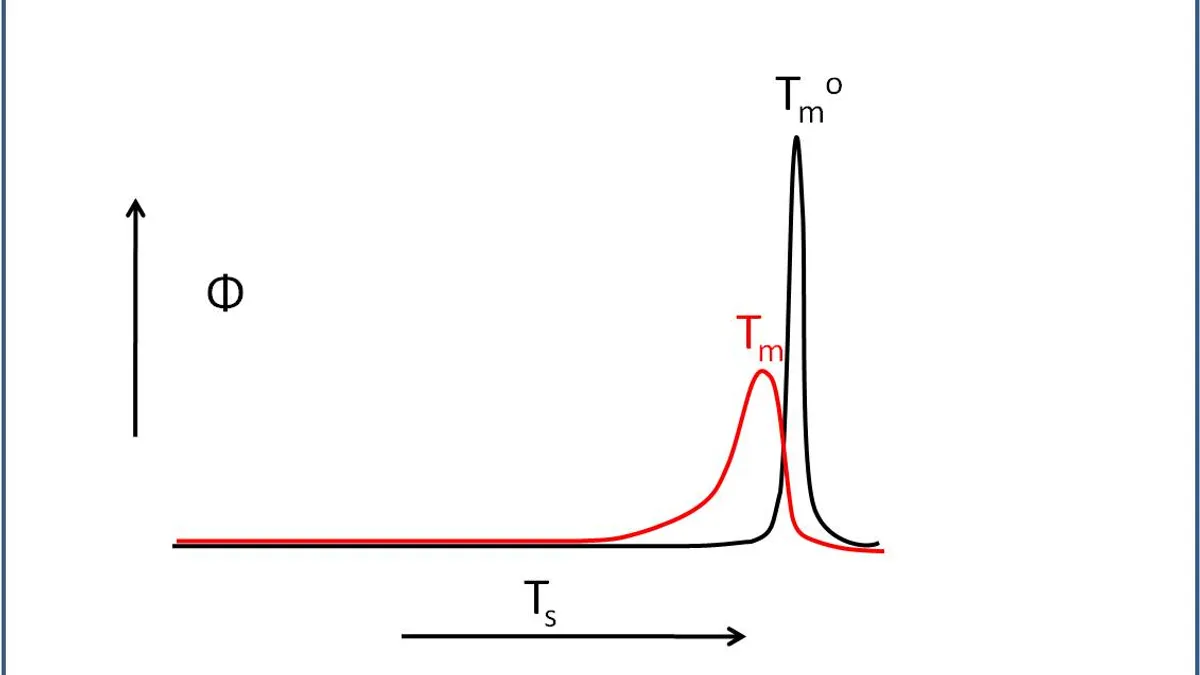
The core concept driving DSC purity analysis is something we observe in everyday life: adding salt to ice lowers its melting point. In chemistry, the presence of soluble impurities in a crystalline lattice lowers the melting temperature and broadens the melting range of the substance.
If you analyze an absolutely 100% pure crystal, the melting peak on a DSC thermogram is sharp and narrow. As the impurity level increases (e.g., from 99.9% to 98% pure), the DSC melting peak becomes wider, and the onset temperature shifts to a progressively lower value.
Applying the Van 't Hoff Equation
The mathematical foundation of this phenomenon is the Van 't Hoff law of melting point depression. During the melting process recorded by the DSC, the software continuously integrates the heat flow to determine the fraction of the sample that has melted ($F$) at any given temperature ($T$).
The Van 't Hoff equation correlates the sample temperature $T$ to the fraction melted $F$:
$T_F = T_0 - \frac{R \cdot T_0^2 \cdot X}{\Delta H_f} \cdot \frac{1}{F}$
By plotting the sample temperature ($T_F$) against the reciprocal of the fraction melted ($1/F$), a straight line should theoretically be formed. The slope of this line is directly proportional to the mole fraction of the impurity ($X$). The y-intercept represents the theoretical melting point of the 100% pure substance ($T_0$).
Crucial Limitations and Best Practices
While elegant, the Van 't Hoff method is not a magic bullet. It has strict thermodynamic limitations:
1. The Eutectic Limitation: It only works for impurity levels up to roughly 2-3%. If a substance is 95% pure, the DSC melting curve will not follow ideal Van 't Hoff behavior, and calculations will fail.
2. Solid Solutions: The calculation assumes that impurities are soluble in the melt but completely insoluble in the solid crystal phase. If the impurity forms a solid solution (i.e., embeds itself into the crystal matrix interchangeably), the melting point depression will be inaccurate.
3. Decomposition: If the API undergoes any thermal decomposition during melting, the generated peak is not purely a melting event, and the purity calculation becomes invalid.
Analyzing the Data via Software
Modern thermal analysis software, particularly METTLER TOLEDO's STARe system, automates this complex thermodynamic calculus. The analyst simply brackets the melting peak, and the software applies linearization corrections (to account for thermal lag and instrument response) before instantly generating a detailed purity report indicating mol-% purity.
Related Resources
Compare and understand advanced thermal software and regulatory guidelines using these references:
Conclusion
Purity analysis via DSC is an exceptionally rapid and absolute method, acting as the perfect independent cross-check against HPLC profiles. By mastering the execution of the Van 't Hoff equation, pharmaceutical QC labs can confidently release multi-million-dollar API batches, secure in the thermodynamic proof of their purity.
Need Expert Thermal Analysis?
Our METTLER TOLEDO-equipped lab delivers precise, NABL-traceable results for DSC, TGA, RC1, and more.
Book Free ConsultationShare Article
Related Articles
Glass Transition Temperature (Tg): Why it Matters in Pharma
Understand why the Glass Transition Temperature (Tg) is the most critical parameter for ensuring the stability of amorphous solid dispersions in pharmaceuticals.
Thermal AnalysisOIT (Oxidation Induction Time): Estimating Polymer Lifespan
Learn how to utilize Oxidation Induction Time (OIT) testing via DSC to predict the thermal degradation resistance and total lifespan of polymers.
Thermal AnalysisAssessing Protein Denaturation with Microcalorimetry
Explore how extreme sensitivity Differential Scanning Calorimetry (DSC) and Microcalorimetry are vital for charting thermal stability and denaturation of proteins.