TGA-FTIR vs TGA-MS: Choosing the Right Hyphenated Technique
Introduction
The golden rule of Thermogravimetric Analysis (TGA) is that it quantifies mass loss impeccably. The golden rule of Evolved Gas Analysis (EGA) is connecting that TGA to an external "sniffer" to identify what exactly is burning off. In the world of elite materials science and reverse engineering, laboratories are generally forced to choose between the two heavyweights of hyphenation: TGA coupled to Fourier Transform Infrared Spectroscopy (TGA-FTIR) or TGA coupled to Mass Spectrometry (TGA-MS).
Both techniques act as forensic lie detectors for materials, but they identify molecules in fundamentally different ways. Making the wrong investment not only wastes hundreds of thousands of dollars but can result in blind spots for critical chemical components. This guide delineates exactly when to deploy infrared light and when to deploy ion bombardment.
TGA-FTIR: The Functional Group Master
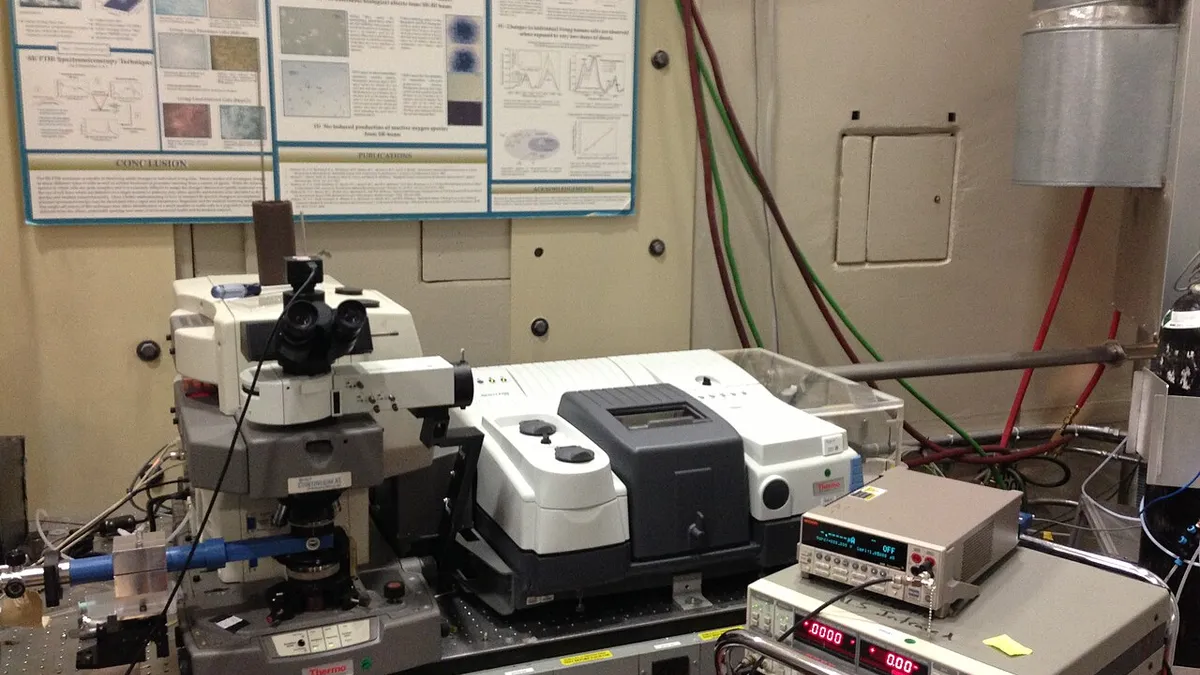
How it Works: The exhaust gas from the TGA is piped into a heated gas cell. An infrared beam shoots through the gas. Different molecular bonds (like C=O double bonds in acetates, or O-H bonds in water) absorb specific frequencies of the infrared light, creating an absorption spectrum.
The Strengths of TGA-FTIR:
- Functional Group Identification: FTIR is unmatched at identifying the type of chemical present. It will instantly tell you if the gas is an alcohol, an ester, a ketone, or an aromatic ring.
- Incredible for Polymers: When a complex polymer degrades, it often releases a vast array of similar hydrocarbon fragments. TGA-FTIR cuts through this noise beautifully, identifying the macro-chemical family leaving the pan.
- Easy Library Matching: Software makes it incredibly simple to match the generated IR spectra against vast commercial libraries (over 100,000 compounds) to identify standard industrial plasticizers, solvents, and adhesives.
- Cost and Robustness: FTIR systems are significantly cheaper to acquire and maintain than high-end Mass Spectrometers, with very few delicate moving parts.
The Weakness: FTIR is entirely blind to symmetrical diatomic molecules. It literally cannot see elemental Nitrogen ($N_2$), Oxygen ($O_2$), or Hydrogen ($H_2$).
TGA-MS: The Isotopic Sniper
How it Works: The exhaust gas enters a vacuum chamber, gets smashed by high-energy electrons, and breaks into charged fragments. The MS then sorts these fragments by their Mass-to-Charge ratio (m/z), tracking exact molecular weights.
The Strengths of TGA-MS:
- Incredible Sensitivity: MS is orders of magnitude more sensitive than FTIR. It can detect parts-per-billion trace toxic off-gassings that wouldn't even register as background noise in an FTIR.
- Detects Everything Symmetrical: Unlike FTIR, MS expertly detects the elemental gases: Oxygen, Nitrogen, Hydrogen, and Argon. This makes it indispensable for analyzing advanced catalysts, oxidation profiles, and battery venting.
- Isotope Tracking: MS can differentiate between water $H_2O$ (mass 18) and heavy water $D_2O$ (mass 20), allowing for wildly advanced isotopic tracer studies in pharmaceutical metabolic testing.
The Weakness: The data is a nightmare to interpret for complex mixtures. If a massive polymer breaks down into 50 different hydrocarbon fragments simultaneously, the MS "cracks" them into thousands of overlapping ions. Without extreme expertise, interpreting a heavily fragmented polymer MS spectrum is nearly impossible.
Case Study: When You Need Both
A pharmaceutical lab was analyzing an advanced Active Pharmaceutical Ingredient (API) that suffered unexplained mass loss at 180°C.
1. They used TGA-MS first. The MS detected a huge spike at m/z 18 (Water) and m/z 44. The team assumed the m/z 44 was Carbon Dioxide ($CO_2$), indicating severe oxidative degradation. However, they were unsure.
2. They ran the sample through TGA-FTIR. The IR spectra proved definitively that the compound evolving was NOT Carbon Dioxide, but rather Nitrous Oxide ($N_2O$, which also has a mass of 44). The FTIR's ability to "see" the chemical bond structure prevented a massive diagnostic error.
To solve this exact issue, industry leaders like METTLER TOLEDO offer TGA systems capable of connecting to MS and FTIR simultaneously (TGA-MS-FTIR), providing the ultimate, unquestionable forensic signature.
Related Resources
Compare specific instruments and spectral guides:
Conclusion
TGA-FTIR is the broadsword; it is rugged, relatively inexpensive, and brilliant at identifying complex polymer degradation and functional groups. TGA-MS is the scalpel; extremely sensitive, highly complex, and perfectly suited for tracking trace gases and structural isotopes. By understanding the profound physical differences between light absorption and ion tracking, laboratories can invest in the precise tool required to uncover their material secrets.
Need Expert Thermal Analysis?
Our METTLER TOLEDO-equipped lab delivers precise, NABL-traceable results for DSC, TGA, RC1, and more.
Book Free ConsultationShare Article
Related Articles
Evolved Gas Analysis (EGA): Linking TGA with Mass Spectrometry
Uncover the forensic power of Hyphenated Techniques. Learn how Evolved Gas Analysis (EGA) linking TGA and Mass Spectrometry identifies decomposition products in real time.
Thermal AnalysisTGA-FTIR Hyphenated Techniques for Deformulation Studies
Discover how coupling Thermogravimetric Analysis with Fourier Transform Infrared Spectroscopy (TGA-FTIR) revolutionizes material deformulation and evolved gas analysis.
PharmaceuticalsGlass Transition Temperature (Tg): Why it Matters in Pharma
Understand why the Glass Transition Temperature (Tg) is the most critical parameter for ensuring the stability of amorphous solid dispersions in pharmaceuticals.