Dynamic Mechanical Analysis (DMA) in Polymer Characterization
Introduction
In the physical world, solid materials are rarely purely elastic like a perfect steel spring, nor are they purely viscous like water. Instead, advanced materials such as polymers, elastomers, and composites display viscoelastic behavior—meaning their mechanical response is heavily dependent on temperature, time, and the frequency of applied stress. To engineer safe tires, durable aerospace wings, or impact-resistant sporting goods, understanding this viscoelastic nature is critical. This is where Dynamic Mechanical Analysis (DMA) proves indispensable.
DMA applies an oscillatory, dynamic force to a sample while precisely regulating temperature, yielding continuous data on a material's stiffness and energy dissipation characteristics. In this deep dive, we will explore the fundamental principles of DMA, its crucial applications in modern material engineering, and the best practices required to obtain accurate, reproducible mechanical data.
The Basics of Dynamic Mechanical Analysis (DMA)
While a standard tensile tester pulls a sample until it breaks (providing a single snapshot of ultimate strength), a DMA gently oscillates the sample, measuring its response continuously across a wide temperature range without causing destruction.
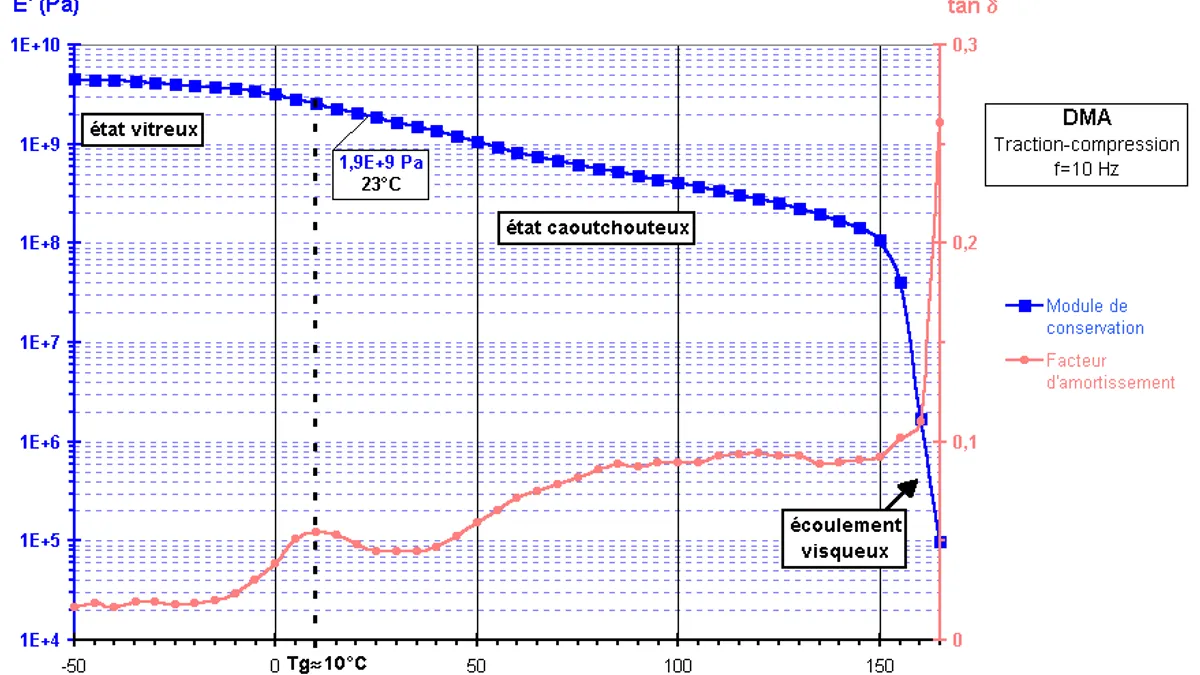
When a sinusoidal stress is applied to a viscoelastic polymer, the resulting strain is neither perfectly in-phase (as in a purely elastic solid) nor perfectly out-of-phase (as in a purely viscous liquid). It lags behind the stress by a phase angle denoted as delta ($\delta$). DMA mathematically resolves this dynamic response into two critical, distinct moduli:
1. Storage Modulus ($E'$ or $G'$): This represents the elastic portion of the material's behavior. It perfectly correlates to the material's stiffness and its ability to store mechanical energy and return it upon the removal of the load.
2. Loss Modulus ($E''$ or $G''$): This represents the viscous portion of the material. It measures the material's ability to dissipate mechanical energy into heat.
The ratio of the Loss Modulus to the Storage Modulus is known as Tan Delta ($\tan \delta = E''/E'$). Tan delta is the measure of material damping. A high tan delta means the material is great at absorbing impact and sound (like an acoustic dampening foam), while a low tan delta indicates a bouncy, resilient material (like a high-performance golf ball or tire tread).
Through a typical DMA temperature ramp, you will prominently observe the glass transition (Tg) as a massive, sharp drop in the storage modulus and a corresponding distinct peak in the tan delta curve. In fact, due to its mechanical nature, DMA is often 10 to 100 times more sensitive to glass transitions than standard DSC.
Applications of DMA in Material Engineering
Because DMA bridges the gap between thermal properties and tangible physical performance, its applications are vast across heavy industry and high-tech manufacturing.
1. Elastomer & Tire Design (The "Magic Triangle"):
In tire manufacturing, formulators must balance grip (traction), rolling resistance (fuel efficiency), and treadwear. DMA handles this by measuring Tan Delta at different frequencies and temperatures. High Tan Delta at low temperatures/high frequencies predicts good wet-grip handling, while a low Tan Delta at higher temperatures/lower frequencies predicts low rolling resistance. DMA is the defining tool used to tune silica and carbon black fillers to perfect this balance.
2. Curing Kinetics of Thermosets & Composites:
For aerospace grade epoxies and carbon fiber composites, DMA tracks the curing process. As a liquid resin chemically crosslinks into a solid, its storage modulus skyrockates. Engineers use DMA to identify the exact gel point (where the material transitions from liquid to solid) and vitrification point, optimizing autoclave curing cycles to save time and energy without compromising part strength.
3. Predicting Long-Term Creep (TTS Method):
If you apply a constant load to a plastic pipe for 10 years, will it deform and burst? You can't run an experiment for 10 years. DMA solves this using Time-Temperature Superposition (TTS). By running fast frequency sweeps at multiple elevated temperatures, DMA software can generate a "master curve" that accurately predicts polymer creep and stress relaxation over decades, securing long-term infrastructural safety.
Case Study: Optimising Vibration Dampening Mounts
An industrial equipment manufacturer approached Enthalpy Labs facing catastrophic fatigue failures. Their heavy-duty machinery required thick rubber motor mounts to absorb high-frequency engine vibrations. However, the existing rubber mounts were transmitting vibration rather than absorbing it, leading to structural cracks in the surrounding chassis.
Traditional static compression tests had shown the rubber possessed the correct physical hardness (Durometer). It was only when we performed a DMA frequency sweep at operational temperatures that the flaw was revealed.
The DMA data showed that at the high operating frequency of the engine (100 Hz), the current rubber formulation's Tan Delta plummeted, and its storage modulus increased dramatically—the rubber was undergoing the "glassy" behavior dynamically, acting like a solid piece of plastic rather than an elastic damper.
Guided by the DMA readouts, the client added an engineered plasticizer to their formulation to shift the peak of the Tan Delta curve directly over their 100 Hz operating frequency range. The new mounts maximized energy dissipation efficiently, ending the fatigue failures outright.
Comparison: DMA vs TMA vs DSC
It is crucial to know when to deploy DMA versus other thermal techniques.
DMA (Dynamic Mechanical Analysis):
Measures stiffness, damping, and viscoelastic shifts. It is the most sensitive technique for detecting sub-Tg secondary transitions ($\beta$ and $\gamma$ relaxations) which relate directly to the impact toughness of plastics at cold temperatures. It perfectly characterizes mechanical modulus.
TMA (Thermomechanical Analysis):
Applies a static, non-oscillating force (or near-zero force) primarily to measure dimensional changes. TMA is the preferred tool for calculating precise Coefficients of Thermal Expansion (CTE), studying swelling, or observing simple softening points. It tells you how much a part will grow, but not how stiff it is.
DSC (Differential Scanning Calorimetry):
Measures shifts in heat capacity and latent heat. DSC is exceptional for measuring melting points and percent crystallinity, which DMA cannot reliably quantify. However, DSC often misses subtle or broad glass transitions in heavily crosslinked resins, an area where DMA shines.
Best Practices for Valid DMA Results
Producing flawless DMA data requires more hands-on finesse than other thermal techniques.
1. Perfect Sample Geometry: The math used by the DMA to convert measured stiffness into pure Modulus relies on the physical dimensions of the sample. The sample must be perfectly flat, parallel, and accurately measured with precise calipers. Variations in thickness will exponentially distort the calculated Modulus.
2. Choose the Right Deformation Mode: DMA clamps come in various configurations: Dual Cantilever, 3-Point Bending, Tension, Compression, and Shear. Thermoplastics usually require bending, thin films and fibers require tension, and soft gels/rubbers require shear or compression. Putting a stiff composite in shear will result in poor, noisy data.
3. Mind the Aspect Ratio: In bending modes, the ratio of the sample's length to its thickness must be high enough (typically > 10:1) to prevent shear effects from corrupting the bending modulus measurement.
4. Isothermal Steps vs Ramping: For high-precision frequency sweeps aimed at TTS master curves, always step the temperature and wait for equilibrium before measuring, rather than ramping dynamically.
Conclusion
Dynamic Mechanical Analysis is the definitive bridge connecting the molecular architecture of a material to its real-world engineering performance. From maximizing the lifespan of aerospace composites to perfecting the wet grip of winter tires, understanding the balance between storage modulus and tan delta empowers manufacturers to innovate fearlessly.
At Enthalpy Labs, our advanced METTLER TOLEDO DMA systems, combined with world-class analytical expertise, provide the exact viscoelastic roadmaps you need. Whether optimizing a cure cycle or analyzing failure under dynamic load, DMA ensures that your materials will perform exactly as engineered when the pressure is on.
Related Resources
- METTLER TOLEDO DMA Solutions
- Viscoelasticity PubMed Literature
- Practical Guide to Polymer DMA (YouTube)
- ICH Storage Guidelines

Need Expert Thermal Analysis?
Our METTLER TOLEDO-equipped lab delivers precise, NABL-traceable results for DSC, TGA, RC1, and more.
Book Free ConsultationShare Article
Related Articles
Dynamic Mechanical Analysis (DMA) vs DSC
Compare Dynamic Mechanical Analysis (DMA) and DSC. Learn how DMA captures the mechanical glass transition and viscoelastic properties that DSC cannot.
Materials ScienceThermal Testing for 3D Printing Resins
Discover how Photo-DSC and DMA are critical analyzing UV-curable resins, evaluating cure depths, and mapping isotropic strength in additive manufacturing.
Thermal AnalysisOIT (Oxidation Induction Time): Estimating Polymer Lifespan
Learn how to utilize Oxidation Induction Time (OIT) testing via DSC to predict the thermal degradation resistance and total lifespan of polymers.