DSC for Evaluating the Crystallinity of Semitransparent Polymers
Introduction
In the world of consumer packaging and high-end optics, the balance between strength and transparency is a delicate one. Many of the plastics we use daily—such as Polyethylene (PE) and Polypropylene (PP)—are semitransparent because they contain both amorphous (random) and crystalline (ordered) regions.
The "Degree of Crystallinity" is the primary lever that dictates a polymer's properties. High crystallinity means a stiffer, stronger, and more opaque material. Low crystallinity results in a softer, more flexible, and more transparent product. For manufacturers of everything from soda bottles to medical tubing, Differential Scanning Calorimetry (DSC) is the mandatory tool for ensuring that every batch of plastic has the perfect crystalline ratio.
The Thermodynamic Determination of Crystallinity
Crystallinity cannot be measured directly by sight; it requires a thermodynamic "melting" experiment.
The DSC Protocol:
1. The Melt Scan: The polymer sample is heated through its melting point. The DSC records the "Enthalpy of Fusion" ($\Delta H_m$), which is the total area under the melting peak.
2. The Calculation: To find the percentage of crystallinity, we divide the measured enthalpy by the "Theoretical Enthalpy of a 100% Crystalline Polymer" ($\Delta H_{100\%}$) for that specific material (e.g., 293 J/g for Polyethylene).
$$\% \text{ Crystallinity} = \frac{\Delta H_m}{\Delta H_{100\%}} \times 100$$
A DSC scan that returns 146 J/g for a PE film immediately tells the engineer that the material is exactly 50% crystalline. This quantitative data is the bedrock of plastic quality control.
Impact on Optical Clarity and Haze
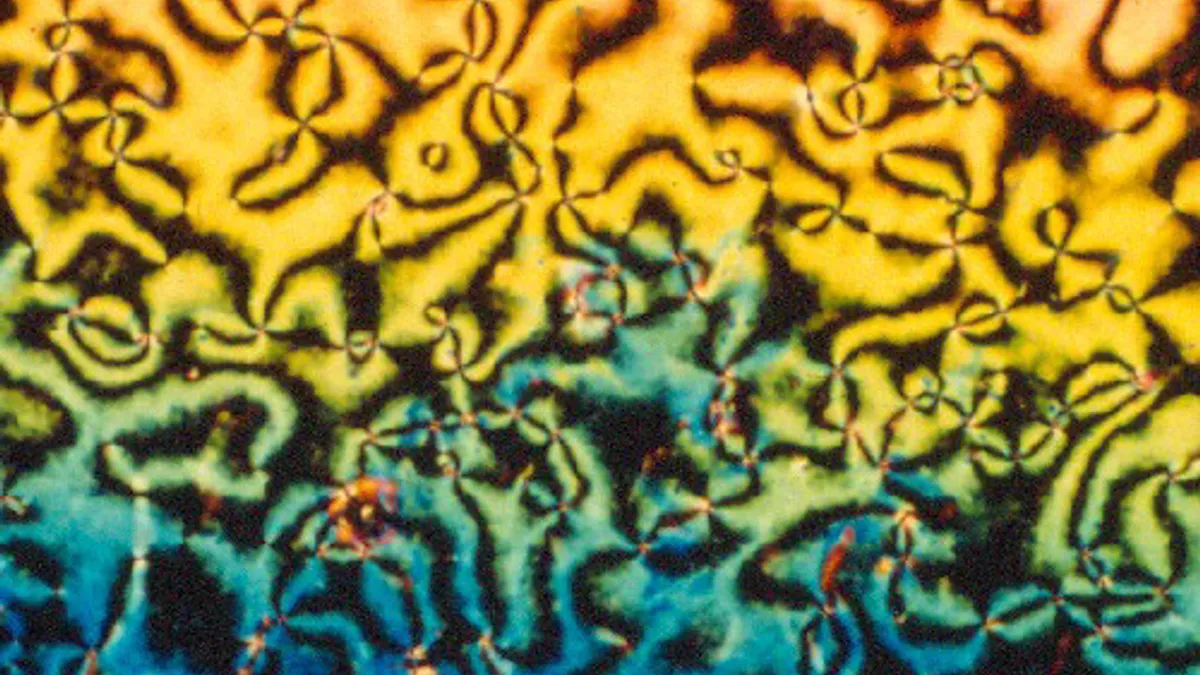
Why does crystallinity affect transparency? In a semitransparent polymer, the crystalline regions (spherulites) are large enough to scatter light. If the crystals grow too large, the plastic becomes "hazy" or milky white.
By Using DSC to monitor the "Cold Crystallization" and the width of the melting peak, packaging engineers can optimize their cooling rates. Fast cooling prevents large crystals from forming, keeping the polymer in a more amorphous state and ensuring crystal-clear "glass-look" transparency for premium consumer products.
Case Study: Solving Brittle Failures in Bio-Plastic Lids
A major food brand was transitioning to a semitransparent, bio-based Polylactic Acid (PLA) for their coffee cup lids. However, the lids were irregularly fracturing during shipping.
Enthalpy Labs used a METTLER TOLEDO DSC to profile the lids. The analysis revealed that the lids had a crystallinity of 42%, which was 15% higher than the design specification. The high crystallinity made the lids stiff but extremely "brittle." The DSC data traced the issue back to a slow cooling phase in the factory's thermoforming machine. By increasing the chilled-water flow to the mold, the company reduced the crystallinity to a stable 30%, eliminating the fractures while maintaining sufficient optical clarity.
Best Practices for Crystallinity Testing
- Consistent History: A polymer's "thermal history" (how it was cooled previously) dominates its crystallinity. Always perform a "second heating scan" to see the material's true potential, but rely on the "first scan" to understand the quality of the finished part.
- Baseline Integration: In semitransparent polymers, the melting peak can be broad. Use a "linear baseline" and integrate from the first sign of deviation to the end of the melt for the most accurate enthalpy value.
- Sample Weight: Because polymers are often inhomogeneous, use a sample weight of 5mg to 10mg to ensure the result represents the bulk material rather than a localized defect.
Related Resources
Explore more about polymer physics and thermal characterization:
- METTLER TOLEDO DSC Systems
- Society of Plastics Engineers - Material Science
- Polymer Crystallization Research
Conclusion
Transparency in plastics is not a matter of luck; it is a matter of crystalline control. Differential Scanning Calorimetry provides the high-precision thermal data needed to engineer polymers that are as clear as glass and as tough as steel. In the competitive landscape of modern packaging, DSC is the invisible lens that ensures your product looks perfect and performs flawlessly.
Need Expert Thermal Analysis?
Our METTLER TOLEDO-equipped lab delivers precise, NABL-traceable results for DSC, TGA, RC1, and more.
Book Free ConsultationShare Article
Related Articles
Understanding the Endothermic Shift: Crystallinity in Polymers
Learn how to interpret endothermic shifts in DSC curves to determine the percent crystallinity of semi-crystalline polymers like PET and PEEK.
Thermal AnalysisOIT (Oxidation Induction Time): Estimating Polymer Lifespan
Learn how to utilize Oxidation Induction Time (OIT) testing via DSC to predict the thermal degradation resistance and total lifespan of polymers.
Thermal AnalysisUnderstanding Glass Transition Temperature (Tg) via DSC
A comprehensive guide to accurately measuring Glass Transition Temperature (Tg) using Differential Scanning Calorimetry (DSC), crucial for polymer and pharmaceutical stability.