Evaluating the Shelf Life of Lyophilized Pharmaceuticals
Introduction
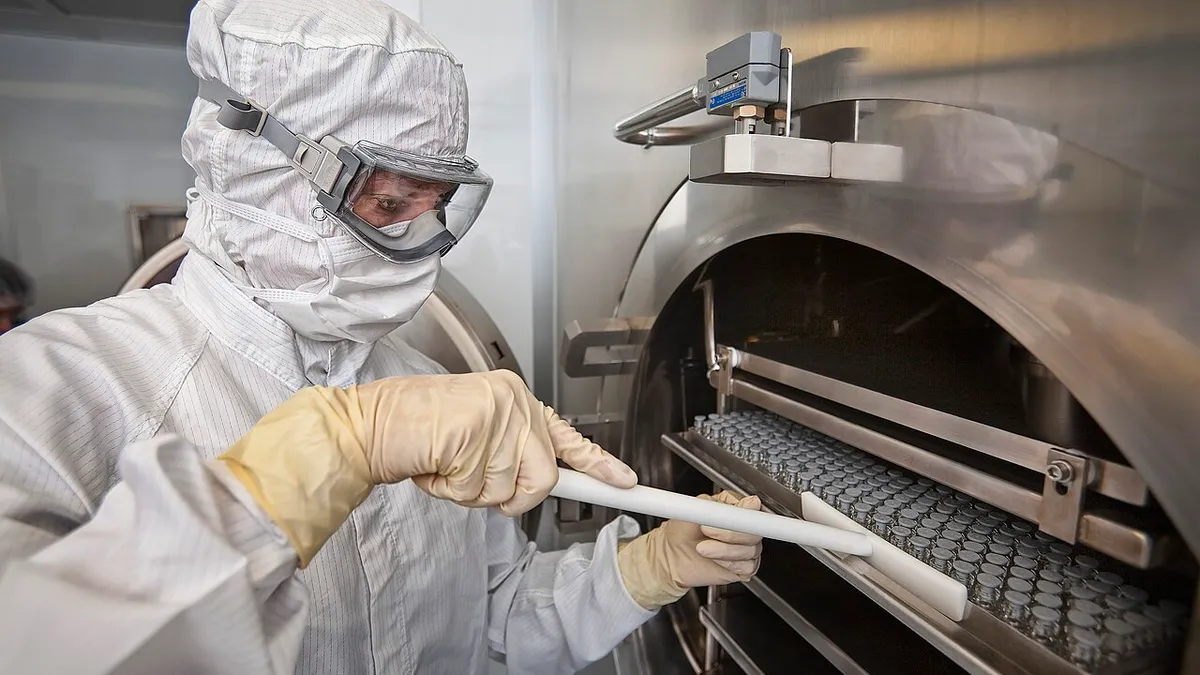
The majority of advanced, life-saving biologic drugs—spanning monoclonal antibodies, peptide hormones, and mRNA vaccines—are deeply unstable when suspended in liquid water. Over time, the water degrades the delicate proteins through hydrolysis and aggregation. To survive global shipping routes and sit on a pharmacy shelf for two years, these drugs must have the water removed through an extreme freeze-drying process known as Lyophilization.
The goal of lyophilization is to lock the delicate protein inside an elegant, highly porous, sponge-like "cake" of excipients (primarily sugars like sucrose or trehalose). However, this solid matrix is precariously balanced. Validating the structural integrity, residual moisture, and absolute Glass Transition Temperature (Tg) of this cake is a primary mandate in biopharmaceutical QA, requiring intensive DSC and TGA testing.
The Threat of Structural Collapse
Lyophilized cakes are inherently amorphous formulations. The primary thermodynamic mechanism keeping them intact is the Glass Transition Temperature (Tg).
As long as the environmental storage temperature (e.g., 25°C room temp or 4°C cold chain) remains significantly below the Tg of the cake (which is ideally 50°C to 70°C), the matrix remains a hard "glass." The proteins trapped inside cannot move, cannot degrade, and remain perfectly preserved.
However, if the Tg drops below the storage temperature, the matrix transitions into a "rubbery" state. The elegant, porous cake literally melts and collapses into a sticky, dense syrup at the bottom of the vial. The proteins inside immediately aggregate, destroying the medical efficacy of the batch.
Quantifying the Tg via Modulated DSC
Standard DSC often struggles with lyophilized cakes because the heat capacity shift of the glass transition is infinitesimally small, and the material inevitably off-gasses trace moisture during the test, blowing out the baseline.
Biopharma utilizes Temperature-Modulated DSC (MDSC) to overcome this. By applying a sinusoidal temperature oscillation over the heating ramp, MDSC mathematically isolates the weak Tg step into the "Reversing" signal, pushing all the messy moisture evaporation artifacts into the "Non-Reversing" signal. This allows analysts to pinpoint the exact Tg of the biologic cake with an accuracy better than 0.5°C, providing concrete assurance that the formulation will survive without collapsing.
Checking Residual Moisture via TGA and DVS
Why would a cake's Tg suddenly drop? The ubiquitous enemy of lyophilization is water. Water is a highly effective plasticizer (it has a Tg of -137°C). Even an extra 1% to 2% of residual moisture trapped in the cake during an incomplete freeze-drying run, or moisture creeping in later through a faulty rubber vial stopper, can depress the cake's Tg by a devastating 20°C to 30°C.
- TGA (Thermogravimetric Analysis): Used primarily to verify the "loss on drying" immediately after the vials are sealed. TGA is incredibly sensitive, rapidly proving that the batch meets the strict requirement of containing less than 1.5% residual moisture.
- DVS (Dynamic Vapor Sorption): Used during the R&D stage. DVS intentionally subjects the lyophilized powder to varying humidity levels, calculating exactly how much ambient moisture leads to critical Tg depression and structural collapse.
Case Study: Rescuing a Failed Cold Chain
A vaccine distributor reported that a shipment of lyophilized vaccines arrived with collapsed cakes, despite temperature-loggers proving the shipment never exceeded 5°C.
Engineers analyzed the ruined vials using a METTLER TOLEDO DSC and TGA. The TGA confirmed the residual moisture was a terrible 4.5% (instead of the required 1.0%). The heavy moisture plasticized the matrix, lowering the cake's Tg to an astounding -2°C. Because the Tg fell below the 5°C cold chain shipping temperature, the matrix turned rubbery and collapsed in transit. The data proved the failure occurred back at the factory during a shortened secondary drying cycle, completely exonerating the logistics company.
Related Resources
Compare advanced biopharma guidelines and stability frameworks:
Conclusion
Lyophilization performs a medical miracle by freezing biological time, transforming fragile liquids into stable solid-state therapeutics. Yet, this stability is a continuous thermodynamic tightrope walk. By masterfully employing Modulated DSC to monitor the rigid Glass Transition boundaries and enforcing aggressive moisture limits via high-resolution TGA, pharmaceutical scientists ensure that freeze-dried cures reach the patient exactly as potent as the day they were manufactured.
Need Expert Thermal Analysis?
Our METTLER TOLEDO-equipped lab delivers precise, NABL-traceable results for DSC, TGA, RC1, and more.
Book Free ConsultationShare Article
Related Articles
Glass Transition Temperature (Tg): Why it Matters in Pharma
Understand why the Glass Transition Temperature (Tg) is the most critical parameter for ensuring the stability of amorphous solid dispersions in pharmaceuticals.
Thermal AnalysisThe Role of Thermal Analysis in Reverse Engineering
Discover how thermal analysis techniques like DSC and TGA act as molecular forensics tools for reverse engineering competitor products and unknown materials.
Thermal AnalysisMoisture Sorption Analysis (DVS) combined with TGA
Discover the power of Dynamic Vapor Sorption (DVS) combined with high-resolution TGA to quantify moisture uptake, deliquescence, and formulation shelf-life.